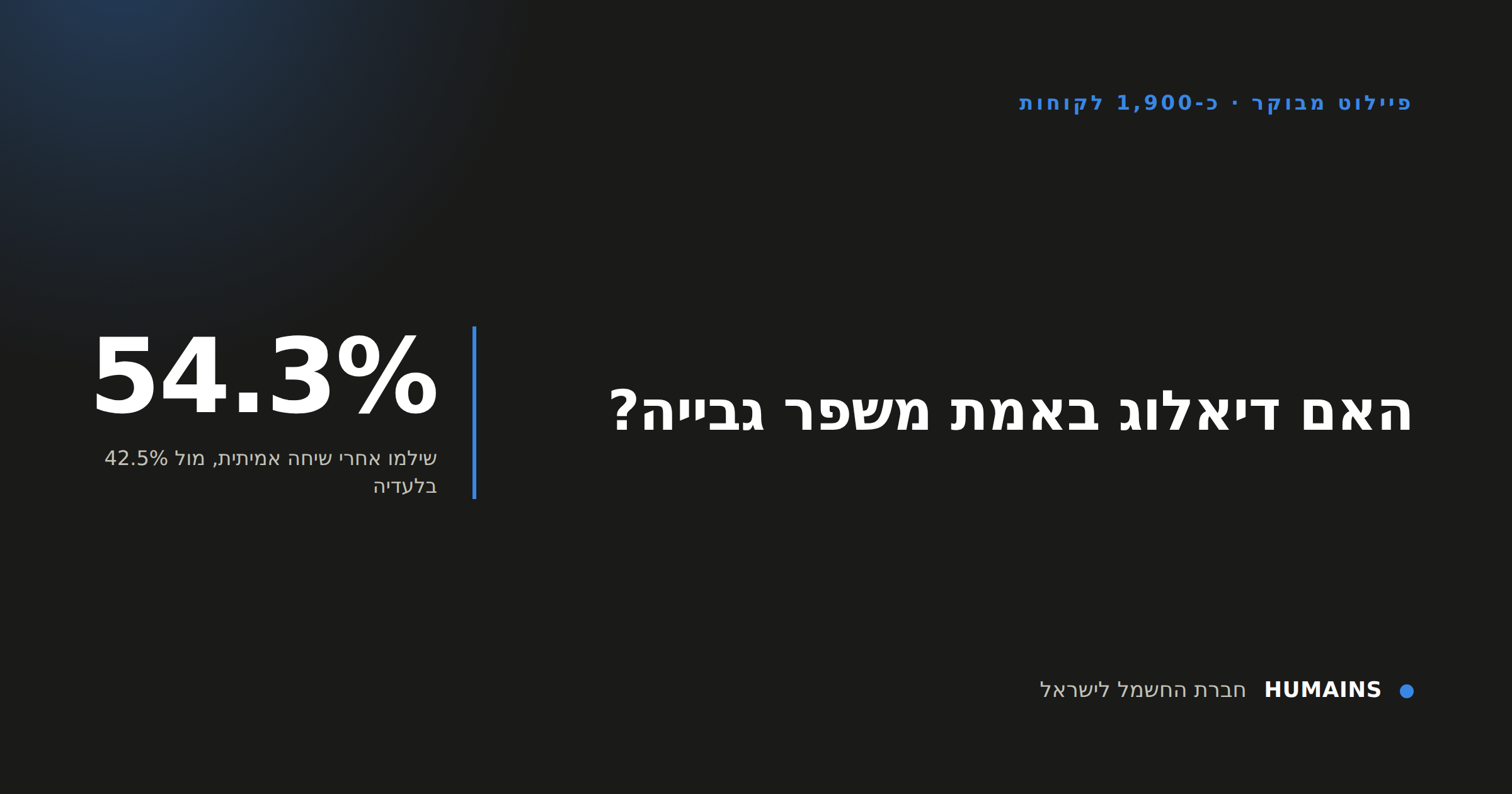
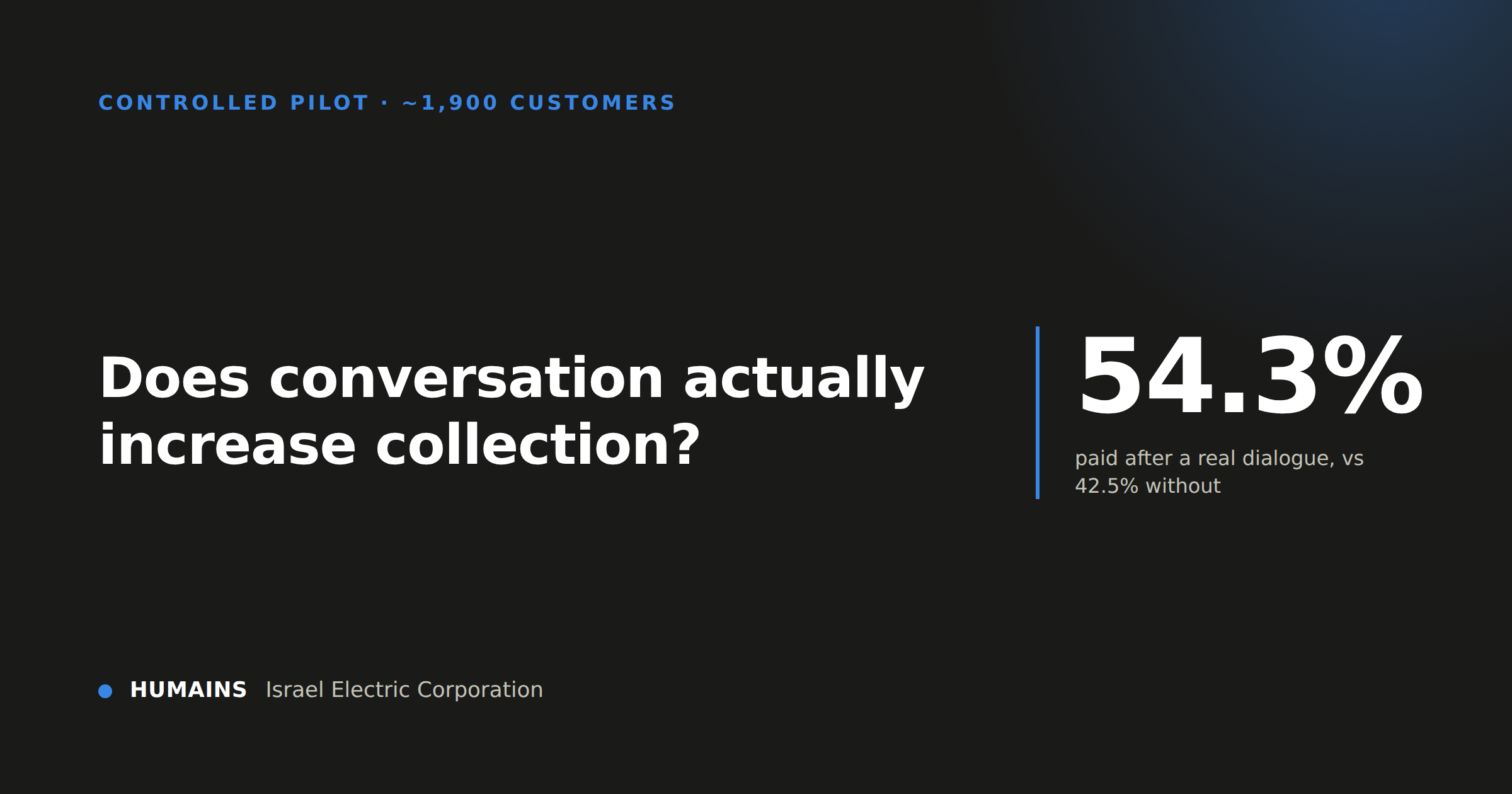
Most claims about AI in collections are vendor arithmetic: a projection, a pilot with no control group, or a percentage with no denominator. This is not that.
Israel Electric Corporation (IEC), the national electricity utility serving essentially every household and business in Israel, ran a three-arm controlled test across 30,000 indebted customers. We are publishing the structure and the rates.
How it was designed
Three groups of 10,000 customers, matched on risk profile and debt characteristics:
Arm | Treatment |
Test | Contacted by an AI collections agent over WhatsApp |
Control 1 | Contacted by the utility's existing human call centre |
Control 2 | Not contacted at all |
Population: younger customer segments at medium-to-high risk, with debts over a defined minimum and aged 30 days or more. Of the test group, 1,469 customers paid before the agent reached them; 8,531 received outreach.
That third arm matters. Almost no published collections study includes a no-contact baseline, which means almost none can separate the effect of the channel from the effect of simply being contacted at all.
The headline result
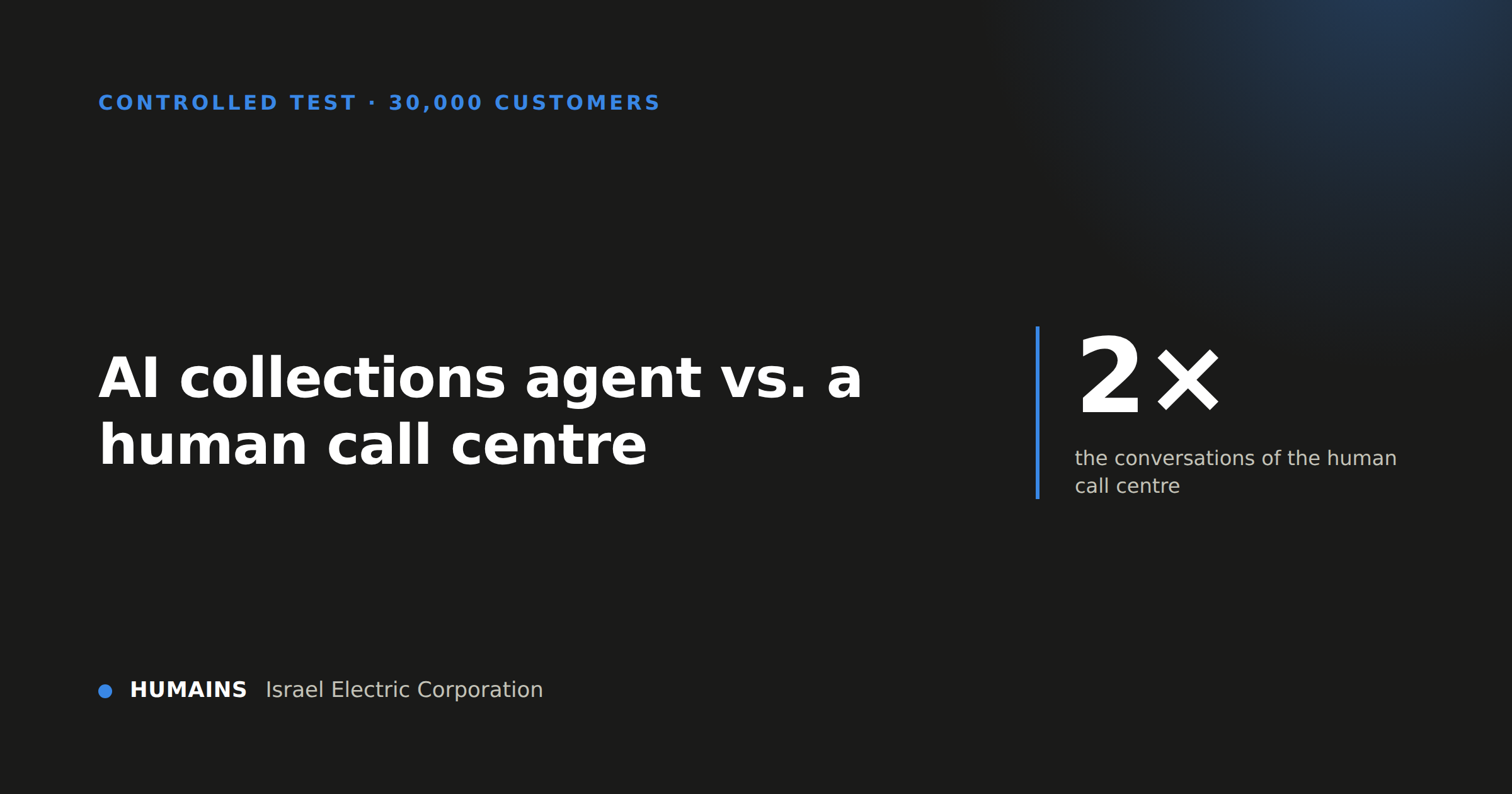
The AI agent held roughly twice as many conversations as the human call centre.
AI agent | Human call centre | |
Customers who responded | 29% | 14% |
Of those, paid the debt | 40% | 46% |

Read that carefully, because the honest version is more interesting than the marketing version.
The humans converted better once they got someone on the line, 46% against 40%. On persuasion alone, the call centre wins.
But it reached half as many people. And in collections, reach compounds: every conversation that never happens is a debt that ages, and aged debt is materially harder to recover.
Incremental recovery, not gross
Net effect on total recovery:
Arm | Total collected |
AI agent | +81% vs. no contact |
Human call centre | +49% vs. no contact |
No contact | baseline |
A head-to-head comparison of the two treated arms puts the agent about 22% ahead of the call centre on gross recovery. That understates the difference.
Most of what any collections arm recovers is money that would have arrived anyway; the no-contact arm collected a substantial amount with zero outreach. Gross totals therefore compare two large, mostly-identical baselines.
The number that measures the channel itself is incremental recovery: what each arm collected above the no-contact baseline.
Arm | Recovery above the no-contact baseline |
AI agent | +81 points |
Human call centre | +49 points |

In incremental terms, the AI agent generated roughly 1.7x the recovery of the human call centre, about 65% to 70% more new money.
The result that surprised us
The AI agent's group carried older debt than the control, debt concentrated in higher age bands, which is consistently harder to collect. It outperformed anyway, and it outperformed across every debt-size band tested.
That is the opposite of what you would expect if the agent were simply skimming the easy accounts.
What is actually going on
Not that AI is more persuasive than a human. It is not. The conversion data says so plainly.
It is that a human call centre is capacity-bound. It works a queue, in business hours, at a fixed rate. An AI agent contacts the entire book at once, responds whenever the customer chooses to reply, and never runs out of hours. The 29% versus 14% gap is not a persuasion gap. It is an availability gap.
Which means the right framing is not "replace your collectors." It is this: let the agent take the volume so your people can take the accounts where persuasion actually pays. The 46% conversion rate your humans achieve is the reason to route the hard cases to them, not the reason to keep them dialling the easy ones.
One caveat, stated plainly
This test ran alongside an interest-waiver campaign, which lifted payment rates across the board. Absolute rates here are higher than a normal collections cycle would produce.
The comparison still holds, because all three arms had the same offer, but anyone quoting the absolute numbers out of context would be overstating them.
What this means if you run a collections operation
Contact rate is the constraint, not conversion rate. Most collections improvement programmes optimise scripts. The data says optimise reach first.
Debt age is the enemy. Anything that gets a conversation to happen sooner is worth more than anything that makes it slightly more persuasive.
Measure against a no-contact arm, and report incremental, not gross. Without a no-contact baseline you cannot tell how much of your recovery would have happened anyway. Most collections reporting quietly takes credit for it.
Israel Electric Corporation, May 2025. Figures are response, payment and recovery rates from a controlled three-arm test across 30,000 customers. Absolute amounts withheld at the customer's request.
AI Collections Agent vs a Human Call Centre: a 30,000-Customer Controlled Test at Israel Electric Corporation
Add paragraph text. Click “Edit Text” to update the font, size and more. To change and reuse text themes, go to Site Styles.
July 27, 2026
Recent articles