Every collections vendor now says "conversational." Almost none has measured whether the conversation is doing anything, or whether the same result would come from a well-timed reminder.
We measured it. Here is what happened.
The setup
Roughly 1,900 indebted customers at Israel Electric Corporation (IEC), Israel's national electricity utility, split into a test group of 898 and a control group of 968. Average debt age at the start: 45 days.
The test group received a WhatsApp message from an AI agent, with a link to a personalised interface where they could continue in text or voice, in Hebrew. The agent addressed each customer by name, verified identity, explained the debt, answered questions and offered an immediate payment link. Customers who did not respond received up to two follow-ups over about a week.
The control group was handled normally.
Result 1: the agent outperformed the control
Test | Control | |
Customers who paid | 46.5% | 30.9% |
Average recovered per customer | +64% | baseline |
51% more customers paid. That alone would be a good result.
Result 2: conversation itself moved the number
Now split the test group by whether a real conversation happened:
Within the test group | Paid |
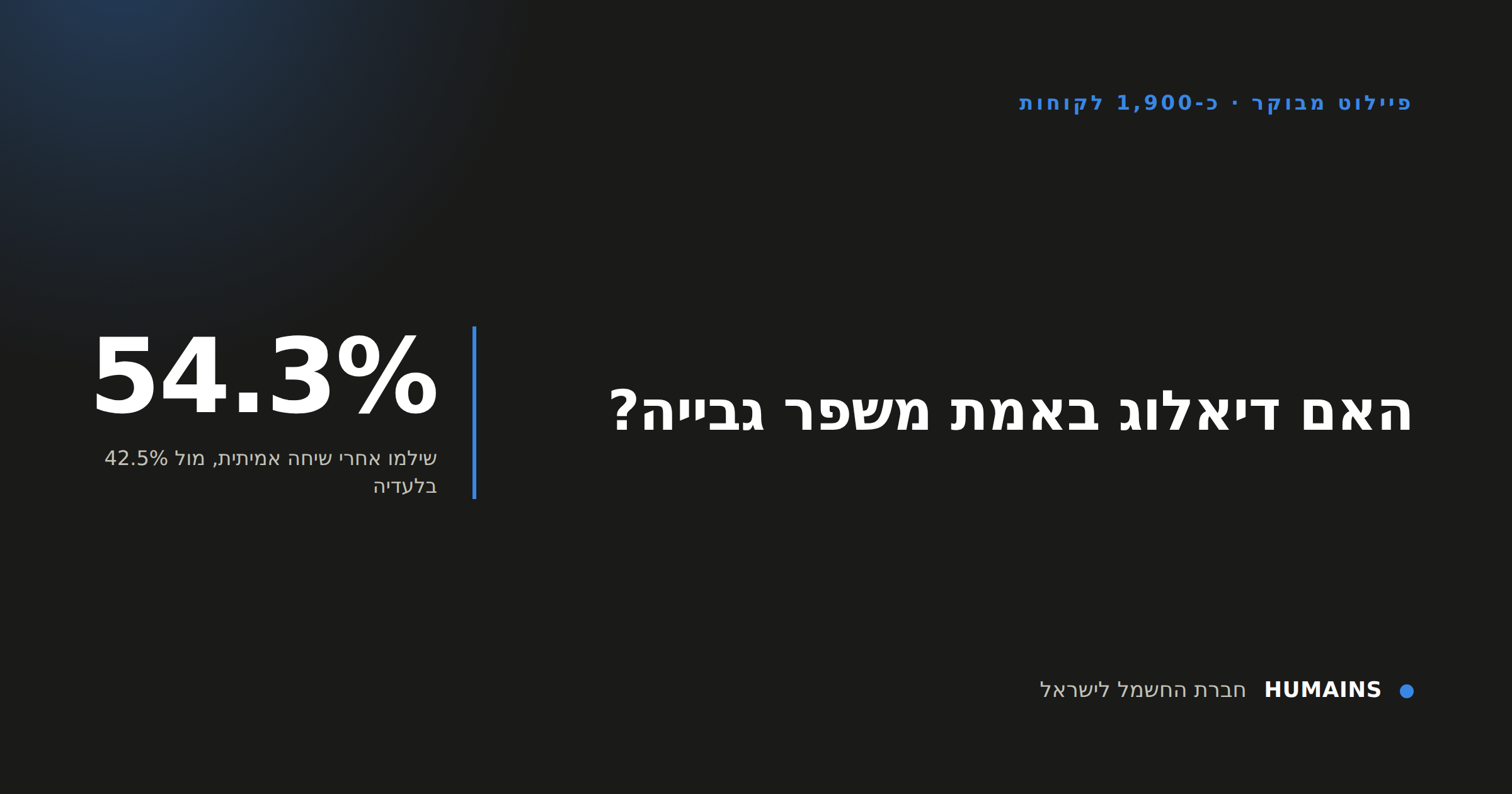
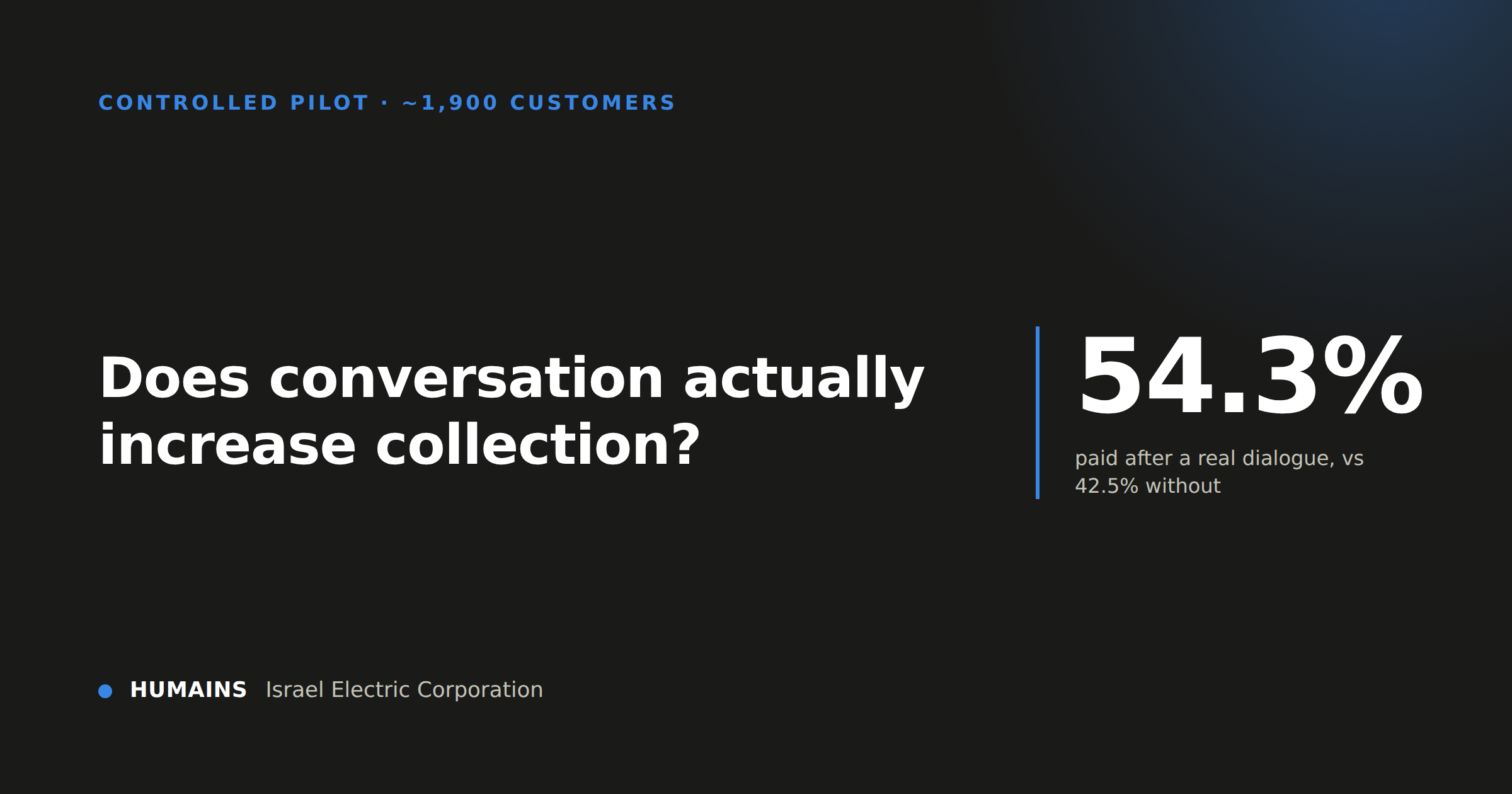
Held a dialogue and identified themselves | 54.3% |
Received the message, no dialogue | 42.5% |
A conversation raised the likelihood of payment by 1.28x over two weeks, and by 1.9x when measured one week from the conversation itself.
This is the finding we care about most, because it isolates the variable everyone assumes and nobody tests. Both groups got the message. Both knew about the debt. The only difference was whether a conversation actually took place.
36.8% of the test group engaged with the agent.
Result 3: speed
Payment timing diverged sharply:
Test | Control | |
Paid by day 5 | 25.4% | 11% |
At the median, the test group was collecting at 2.5x the control's rate. Over 20% of the book was recovered within five days.
We stopped all outreach on day seven. A week later the gap had settled at roughly 1.5x the control, which means the effect was not purely pull-forward. Some of it was genuine incremental recovery.
The operational implication: because an agent contacts everyone simultaneously rather than working a queue, you can recover a fifth of a portfolio inside a working week.
Result 4: it was strongest where collection is hardest
On debts aged 61 days or more:
Collected | |
Test group | 44% |
Control | 22.2% |
Twice the recovery on the oldest debt. In the control group, recovery fell steadily once debt passed 40 days, the familiar decay curve every collections team knows.
That decay is where portfolio value dies. An agent that holds up in the 61-day-plus band is not just recovering more; it is stopping debt from ageing into the band where it stops being recoverable at all.
What we take from this
Reminders and conversations are not the same product. A reminder tells someone they owe money. A conversation lets them ask why the amount is what it is, whether they can split it, what happens if they do not, and then removes the friction while the answer is still fresh.
The 54.3% versus 42.5% gap is what that difference is worth, measured rather than asserted.
Israel Electric Corporation pilot, September 2024. Approximately 1,900 customers, test and control. Absolute amounts withheld at the customer's request.
Does Conversation Actually Increase Debt Collection? We Ran the Controlled Test
Add paragraph text. Click “Edit Text” to update the font, size and more. To change and reuse text themes, go to Site Styles.
27 ביולי 2026